


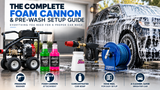




The Complete Foam Cannon & Pre-Wash Setup Guide for a Proper Car Wash

A proper pre-wash foam layer does more than look satisfying dripping down a hood. It lifts and encapsulates dirt before a mitt ever touches the paint, which is exactly the step that cuts down on the swirl marks a straight-to-contact wash tends to cause.
This guide covers the full setup, pressure washer, foam cannon, soap, and hose management, plus the no-pressure-washer alternative for anyone not ready to buy equipment yet. If dialing in the right soap is still an open question, our guide on concentrated car wash soap covers exactly what to look for before it ever hits the foam cannon reservoir.
Everything below comes from Lane's Car Products.
Do You Need a Pressure Washer for a Foam Cannon?
Yes, a true foam cannon requires a pressure washer to work. It uses the washer's pressure to aerate a soap mixture into thick, clinging foam that coats the entire panel and holds there instead of sliding straight off.
A foam gun is the different tool people often confuse it with, running off a standard garden hose instead, producing a lighter foam without needing a pressure washer at all. Both get soap onto the car before contact. The foam cannon produces denser, longer-clinging foam because of the extra pressure behind it; the foam gun trades some of that thickness for not needing extra equipment.
Foam Cannon Setup: What You Actually Need
-
A gas or electric pressure washer to supply pressure
-
A foam cannon attachment that connects to it
-
A concentrated car wash soap built for foaming
-
A hose reel to keep everything manageable between washes
1. Pressure Washer: Gas or Electric
Electric pressure washers suit most home setups: quieter, no fuel to manage, and plenty of pressure for a foam cannon on a car, truck, or SUV. Lane's electric pressure washer lineup includes wall-mounted and cart-based units built for detail shops and dealerships, which means the same equipment scales from a single driveway to a multi-bay wash setup. Gas units step up from there, trading some quiet for more raw pressure and no dependence on an outlet, which matters for a mobile setup or a shop running multiple cars back to back. Browse the gas pressure washer collection if that fits your setup better.
2. Foam Cannon Attachment
Lane's High Pressure Foam Cannon holds a one-liter reservoir and works with any pressure washer rated up to 5,000 PSI, which covers nearly every consumer and light commercial unit on the market. Adjustable air injection technology controls how thick the foam comes out, and the variable spray nozzle lets you dial in exactly how much detergent mixes into the blast rather than guessing.
A quick-release connector means swapping between the foam lance and a standard rinse nozzle takes seconds, not a full disconnect-and-reconnect cycle.
3. Concentrated Soap Built for Foaming
Not every soap foams the same way through a cannon. Wash & Shine Car Soap is the concentrate detailers and dealerships already reach for, and a rich-foaming formula like Pink Car Shampoo is built specifically around that thick, clinging foam texture a cannon is supposed to produce.
Concentrate matters here more than almost anywhere else in a wash routine, since a foam cannon reservoir dilutes the soap further on its way out, and a weak starting concentrate turns into weak, thin foam that slides off before it can do any work.
4. Hose Reel: The Unglamorous Piece That Saves the Setup
A pressure washer and foam cannon setup is only as convenient as the hose attached to it. A dedicated hose reel keeps that hose from turning into a tangled mess between washes, which sounds minor until a kinked hose is the reason pressure drops mid-wash.
For anyone running a full setup rather than dragging a hose out of a garage corner every weekend, this is the piece that makes the rest of the equipment actually pleasant to use.
No Pressure Washer? Use a Foam Gun Instead
A Garden Hose Foam Gun connects directly to a standard home or commercial garden hose faucet, no pressure washer required. It offers six dilution ratio settings to control exactly how much foam comes out, switches between horizontal and vertical spray patterns, and converts from foam gun to plain sprayer with a quick-release attachment, no bucket needed. Lane's built it specifically to pair with Wash & Shine, loosening dirt and debris from paint the same way a cannon does, just with a lighter foam layer and none of the extra equipment. For anyone not ready to invest in a pressure washer, this is the legitimate middle ground between a bucket wash and a full cannon setup.
How Much PSI Do You Need for a Foam Cannon?

Most foam cannons perform well starting around 1,000 to 2,000 PSI, which covers the majority of consumer electric pressure washers on the market. Lane's foam cannon is rated for use with any pressure washer up to 5,000 PSI, which means it scales from a compact home electric unit all the way up to commercial-grade gas equipment without needing a different attachment.
More PSI generally means thicker, more consistent foam, but even a modest electric unit produces a genuine pre-wash layer, so the equipment does not need to be commercial-grade to get real results.
How to Use a Foam Cannon the Right Way
-
Rinse the car first to knock off loose dirt before foam ever touches the surface.
-
Fill the cannon reservoir with concentrated soap and adjust the mixing ratio according to how dirty the car actually is; heavier grime calls for a richer mix.
-
Apply foam from the bottom up, working against gravity so the layer builds rather than sliding straight down before it can dwell.
-
Let the foam dwell for several minutes. This is the step that does the actual work, giving the foam time to encapsulate dirt before contact, and skipping it turns an expensive pre-wash step into a pointless one.
-
Rinse from the top down before starting the contact wash with a mitt, so the loosened dirt is gone before anything touches the paint directly.
Foam Cannon vs Foam Gun, Side by Side
|
Foam Cannon |
Foam Gun |
|
|
Requires |
Pressure washer |
Garden hose only |
|
Foam density |
Thick, clinging |
Lighter, still effective |
|
Best for |
Regular details, dedicated setups |
Occasional washes, no extra equipment |
|
Setup cost |
Higher, pressure washer plus cannon |
Lower, single attachment |
Frequently Asked Questions
Built for the Wash, Not Just the Shine
Lane's Car Products was built inside a working detail operation, not a marketing department. Since 2000, our parent company, Fast Lane Detailing, has run pre-wash foam setups on real vehicles daily, and more than 40 dealerships trust our made-in-USA equipment and formulas to get that first step right before anything else starts. Learn more on our About Us page.
Ready to build your setup? Shop the Car Detailing Equipment collection for pressure washers, hose reels, and the foam cannon itself, all in one place.
Frequently Asked Questions
Do I need a pressure washer for a foam cannon?
Yes, a true foam cannon uses pressure washer output to aerate soap into thick foam. A foam gun is the alternative that runs off a standard garden hose instead, with no pressure washer required.
What PSI do I need for a foam cannon?
Most foam cannons perform well starting around 1,000 to 2,000 PSI, and Lane's foam cannon is rated for use up to 5,000 PSI. More pressure generally means thicker, more consistent foam, but a modest electric washer still produces real results.
How long should foam dwell before rinsing?
A few minutes is enough for foam to encapsulate and loosen dirt before it needs rinsing. Rinsing immediately after applying skips the step that actually does the work of lifting grime off the paint.
Can I use any soap in a foam cannon?
Concentrated soaps built for foaming work best, since a foam cannon further dilutes whatever goes into the reservoir. A weak or non-foaming soap produces thin, ineffective foam that slides off before it can dwell.